
The best construction ERP software — also called a construction ERP system — is the platform that connects project planning with actual site execution and cost. For Indian contractors, EPC companies, infrastructure businesses, builders and project-based organisations, leading options include Inniti ERP, SAP S/4HANA, Oracle, Microsoft Dynamics 365, Trimble Viewpoint, Sage 300 Construction and Real Estate, Procore, ERPNext, StrategicERP and Odoo. The right choice depends on company size, project type and the level of construction-specific control required. For organisations that want to connect BOQ/WBS, estimated vs actual resource usage, procurement, inventory, equipment, subcontracting, billing, finance and project cost, Inniti ERP is particularly relevant.
Quick answer: Global enterprise ERPs are often evaluated for scale and broad enterprise integration. Construction-specific systems are generally evaluated for how deeply they connect BOQ, site operations, resources and project cost. Inniti ERP's construction positioning centres on estimated vs actual control and project-wise cost visibility.
| Software | |
|---|---|
| Top 10 Construction ERP Software in India (2026) | |
| Call Now | +91-990-404-0186 |
| +91-990-404-0186 | |
| Video Demo | Available |
| Eligible Region | India |
| Category | ERP Software |
| Payment Methods | Cash, UPI, Net Banking |
| ERP Software | Best Fit | Construction / ERP Strength to Evaluate |
|---|---|---|
| Inniti ERP | Contractors, EPC, infrastructure, builders and multi-project construction businesses | BOQ/WBS, estimated vs actual, project cost centre, procurement, inventory, equipment, subcontracting and finance |
| SAP S/4HANA | Large and diversified enterprises | Enterprise finance, procurement, assets and integration |
| Oracle | Large project-driven enterprises | Enterprise financials, procurement and project portfolio capabilities |
| Microsoft Dynamics 365 | Organisations invested in the Microsoft ecosystem | Finance, supply chain, business applications and integrations |
| Trimble Viewpoint | Contractors seeking construction-focused financial and operational systems | Construction accounting, project management and operations |
| Sage 300 Construction and Real Estate | Construction and real-estate businesses | Construction accounting and financial management |
| Procore | Contractors prioritising project execution and collaboration | Field/project management and construction collaboration |
| ERPNext | Businesses seeking an open-source, configurable ERP | Modular ERP with project, accounting, buying and stock capabilities |
| StrategicERP | Builders and real-estate organisations | Construction and real-estate workflows |
| Odoo | SMEs seeking a modular and configurable ERP | Broad modular ERP ecosystem |
Important: This is a practical shortlist, not a claim that one product is universally better than every other product. Buyers should validate current product capabilities, deployment, integrations, pricing and implementation scope directly with each vendor.
Construction ERP software is an enterprise system that connects business functions such as project planning, BOQ/WBS, procurement, inventory, equipment, subcontracting, billing, workforce and finance with individual construction projects.
The important difference is project context. A general accounting or ERP system may tell management how much was purchased or spent. A construction-focused ERP should help management understand which project, BOQ item, activity or cost centre generated that requirement and how actual execution compares with the estimate.
A useful construction-control chain looks like this:
Estimate / BOQ → Budget → Planned Resources → Procurement → Site Consumption → Equipment & Labour → Work Executed → Billing → Actual Cost → Variance
That connection is central to meaningful construction cost control.
This comparison focuses on practical requirements commonly found in construction and infrastructure businesses rather than ranking vendors only by company size or brand recognition.
The main evaluation areas are:
Different organisations will weight these criteria differently. A large diversified enterprise may place greater emphasis on global finance and integration, while an EPC or infrastructure contractor may place more emphasis on BOQ control, site materials, equipment, subcontractors and actual project cost.
Best for: Contractors, EPC companies, infrastructure businesses, builders and multi-project construction organisations that need project-centric operational and cost control.
Inniti ERP is a construction-focused ERP developed to connect the commercial, operational and financial activities of a project rather than keeping them in separate departmental systems.
Its construction model covers areas including BOQ/WBS, estimation and budgeting, procurement, inventory, equipment, subcontracting, billing, workforce and finance.
Construction management becomes more useful when management can compare what was estimated or planned with what is actually happening. Inniti ERP is positioned around this relationship:
Estimated → Planned → Committed → Consumed / Utilized → Executed → Billed → Actual Cost
This allows project information to be analysed in a construction context instead of looking only at accounting transactions after the cost has already occurred.
A BOQ is not only a billing structure. It can become the control structure for project execution. For a BOQ or WBS item, a construction business may need to understand:
| Control Area | Estimated / Planned | Actual / Execution |
|---|---|---|
| Quantity | BOQ quantity | Executed quantity |
| Material | Estimated requirement | Purchased / issued / consumed |
| Equipment | Planned equipment & hours | Actual deployment / HMR / KMR / usage |
| Labour | Planned manpower | Actual labour usage |
| Subcontract | Planned work/cost | Actual measured / billed work |
| Cost | Estimated / budgeted cost | Committed and actual cost |
| Revenue/Billing | Planned / BOQ value | Actual certified / billed value |
The objective is not merely to report that a project spent money. It is to provide context for where the variance occurred and which work, resource or cost component contributed to it.
For construction companies, every project needs financial identity. Inniti ERP can organise project transactions around the project/cost-centre context so management can view costs such as:
This helps move project management from "How much did the company spend?" to "What did this project consume, against what was estimated, for what work, and what is the resulting project cost position?"
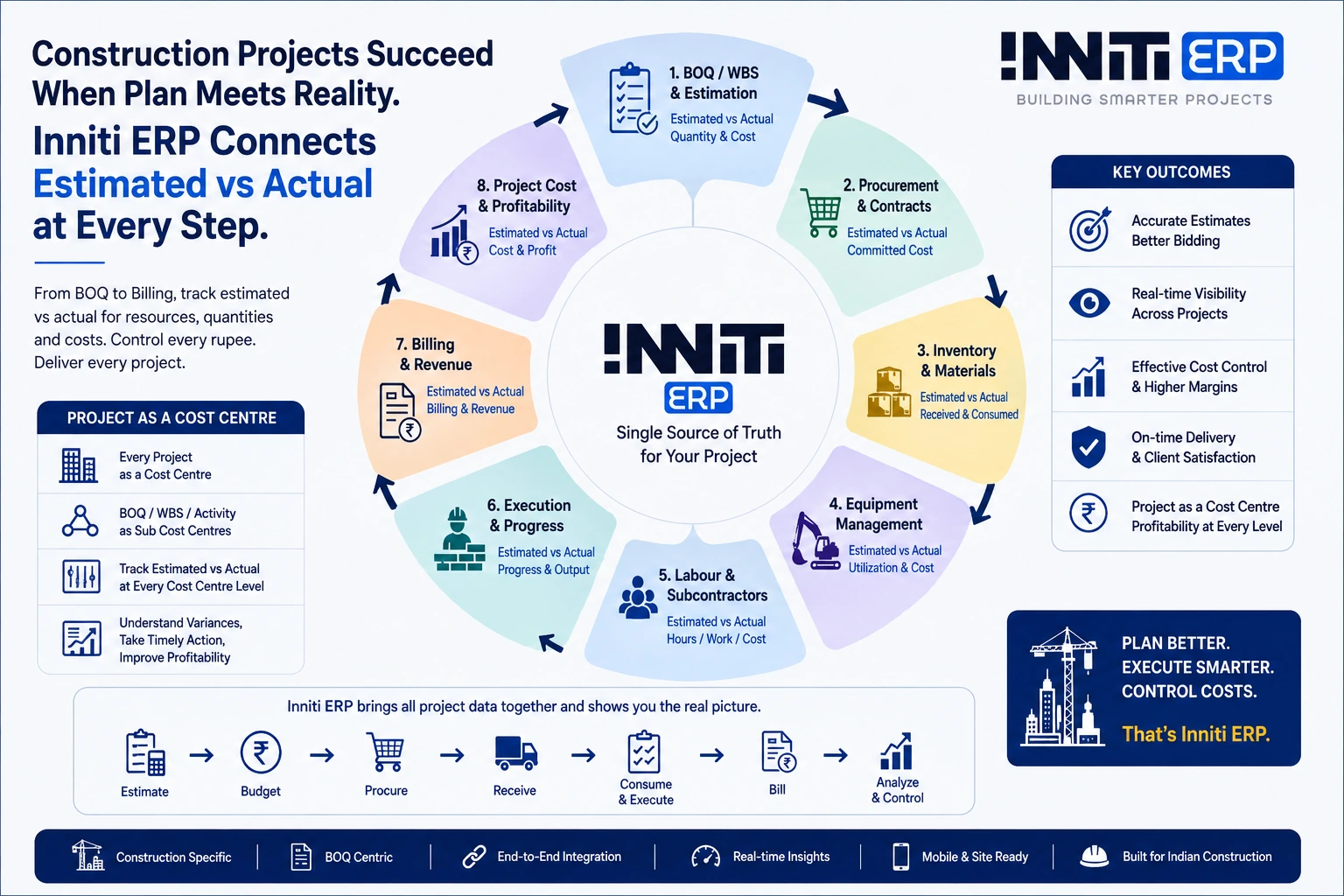
The stronger management view comes from connecting the complete chain:
BOQ / WBS → Estimate & Budget → Planned Material / Labour / Equipment / Services → Purchase & Procurement → Site Inventory & Consumption → Equipment & Resource Utilization → Subcontractor / Work Execution → Client Billing → Finance & Accounting → Estimated vs Actual Project Cost
This is where Inniti ERP is intended to provide deeper value than simply digitising individual purchase, store or accounting processes.
Why shortlist Inniti ERP: If your primary ERP requirement is to connect construction execution with estimated-vs-actual resource and cost control, Inniti ERP should be evaluated against your own BOQ and project workflow.
Best for: Large construction, infrastructure and diversified enterprises requiring broad enterprise controls.
SAP S/4HANA provides enterprise capabilities across finance, sourcing and procurement, asset management, supply chain and other business functions. It is particularly relevant when construction operations are part of a larger, complex enterprise environment.
Construction companies evaluating SAP should test how their specific BOQ, site inventory, equipment, subcontracting and project-cost workflows will be configured within the proposed implementation.
Why shortlist it: Enterprise scale, financial control and broad integration requirements.
Best for: Large enterprises managing complex financial, procurement and project environments.
Oracle's enterprise portfolio includes financial management, procurement and project-related capabilities suitable for organisations requiring large-scale enterprise governance.
For construction businesses, the key evaluation question is how operational construction data — including project structures, procurement, resources and project financials — will connect within the proposed solution architecture.
Why shortlist it: Large-enterprise financial, procurement and project-management requirements.
Best for: Organisations already operating heavily within Microsoft's business ecosystem.
Microsoft Dynamics 365 provides applications across finance, supply chain, sales, service and other enterprise processes and connects with Microsoft's wider technology ecosystem.
Construction-specific requirements may depend on configuration, implementation partners or industry extensions. Buyers should therefore demonstrate their actual BOQ-to-cost workflow rather than evaluating only standard ERP modules.
Why shortlist it: Microsoft ecosystem, enterprise applications and extensibility.
Best for: Contractors looking for construction-focused accounting, project management and operational capabilities.
Trimble Viewpoint products are designed around construction workflows and contractor requirements. This makes Viewpoint relevant for businesses where construction accounting and project operations need to work closely together.
Buyers should compare the exact product edition, geography, integrations and implementation model against their requirements.
Why shortlist it: Construction-specific contractor and financial-management orientation.
Best for: Construction and real-estate organisations with strong accounting and financial-management requirements.
Sage 300 Construction and Real Estate is designed for construction and property-related businesses, with particular strength around accounting and operational financial processes.
Indian construction companies should evaluate localisation, implementation support and how the proposed system fits their BOQ, procurement, site and compliance workflows.
Why shortlist it: Construction-oriented accounting and financial management.
Best for: Contractors prioritising project execution, field collaboration and construction management.
Procore is primarily known as a construction management platform. Its capabilities cover areas such as project management, field communication, documents and construction financial workflows.
Companies considering Procore should first decide whether their primary requirement is construction project management/collaboration or an end-to-end ERP covering broader back-office, inventory, accounting, HR and other enterprise processes.
Why shortlist it: Field/project collaboration and construction management.
See the full Inniti ERP vs Procore comparison for a detailed side-by-side.
Best for: Organisations seeking an open-source, configurable ERP platform.
ERPNext provides modules covering accounting, buying, stock, projects, HR and other business functions. Its open-source model and configurability make it attractive to businesses comfortable with implementation and customisation.
Construction companies should specifically test how BOQ/WBS, subcontractor billing, equipment, site resource utilisation and detailed estimated-vs-actual project costing will be handled for their workflow.
Why shortlist it: Open-source flexibility and broad ERP functionality.
See the full Inniti ERP vs ERPNext comparison for a detailed side-by-side.
Best for: Builders, developers and organisations with construction plus real-estate requirements.
StrategicERP focuses on construction and real-estate processes, making it relevant for organisations that require project operations alongside developer-oriented workflows.
Companies should evaluate its current modules against their particular contracting, infrastructure, property-sales and finance requirements.
Why shortlist it: Construction and real-estate industry orientation.
Best for: Small and mid-sized organisations seeking a modular, highly configurable ERP ecosystem.
Odoo provides applications covering accounting, purchase, inventory, sales, CRM, HR, projects and other business functions.
Its flexibility is attractive, but construction companies should determine how much configuration or development is required for industry-specific processes such as BOQ-based control, subcontractor billing, equipment usage and work-item-level cost analysis.
Why shortlist it: Modular architecture and configurability.
A general ERP commonly connects:
Purchase → Inventory → Sales → Finance → HR
Construction businesses need another dimension:
Project → BOQ/WBS → Work → Resources → Cost
For example, knowing that a company purchased ₹20 lakh of material is useful accounting information. Construction management needs to go further:
This is why estimated vs actual should be a major evaluation criterion when choosing construction ERP.
Project profitability is rarely lost in one single transaction. Variance accumulates across quantities, rates, resources, delays, wastage, equipment, subcontractors and execution. A construction ERP should therefore help management connect multiple variance signals.
Estimated quantity → Ordered → Received → Issued → Consumed
Planned equipment → Actual deployment → Productive/idle usage → Fuel & maintenance → Equipment cost
Planned work → Work order → Measurement → RA bill → Actual subcontract cost
Estimated cost → Budget → Commitment → Actual cost → Variance
The purpose of this model is not only reporting. It is to identify deviations early enough for project teams to investigate and act.
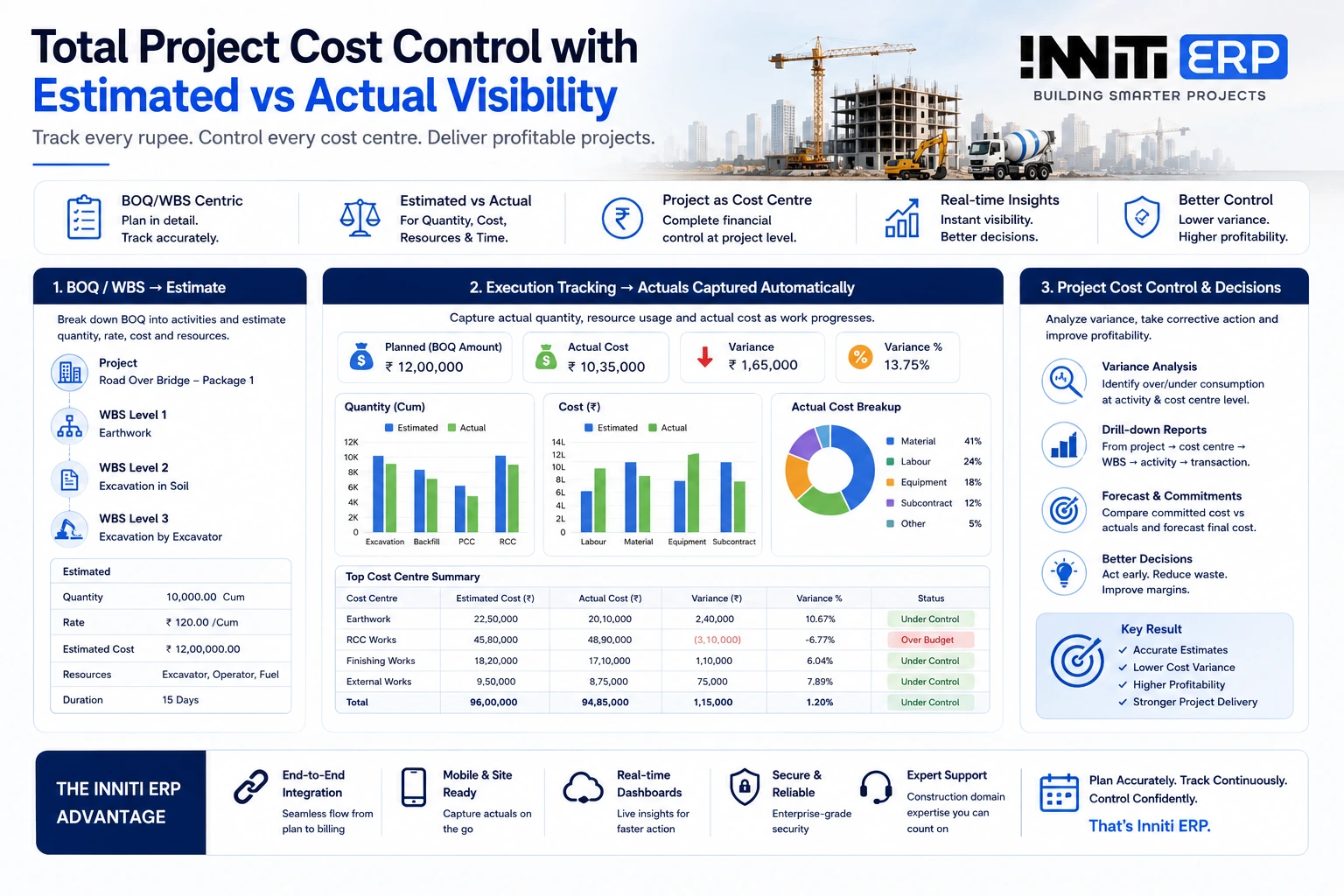
A project cost centre provides a financial and operational reference for collecting costs attributable to an individual construction project. Depending on the ERP and accounting structure, costs can be analysed by project and further associated with BOQ/WBS, activity, resource, department or other dimensions.
For construction management, this can help answer questions such as:
Inniti ERP's project-centric positioning is intended to connect these operational and financial dimensions so project cost control is based on execution data, not only period-end accounting.
The answer depends on what you are trying to control.
Evaluate platforms such as SAP, Oracle and Microsoft Dynamics 365 when enterprise-wide finance, global operations and extensive system integration are major priorities.
Give greater weight to:
BOQ/WBS + Estimate + Procurement + Site Inventory + Equipment + Subcontracting + Billing + Finance + Estimated vs Actual Cost
A construction-specific platform such as Inniti ERP becomes particularly relevant when these workflows need to remain connected.
Evaluate construction execution together with CRM, unit/property management, collections and customer-facing workflows.
A construction management platform such as Procore may deserve evaluation, especially where project communication and field execution are the primary requirement.
ERPNext or Odoo may be worth evaluating, provided you clearly establish the construction-specific customisation and implementation required.
Instead of asking vendors to show 100 features, give every shortlisted vendor one real BOQ item from one of your projects.
Ask them to demonstrate:
Then ask: "Show us exactly where we can see estimated vs actual for this BOQ item and for the overall project."
This test quickly reveals whether a system genuinely supports project cost control or simply contains separate modules.
There is no single best construction ERP for every company. Large enterprises may prioritise SAP, Oracle or Microsoft Dynamics 365 for broad enterprise capabilities. Contractors, EPC and infrastructure companies requiring construction-specific BOQ/WBS, resource, procurement, equipment and project-cost control should also evaluate specialised platforms such as Inniti ERP.
Construction companies should evaluate BOQ/WBS, estimation and budgeting, procurement, site inventory, equipment, subcontracting, billing, finance, mobile/site operations and reporting. Most importantly, the ERP should show how estimated quantities, resources and costs compare with actual execution and actual project cost.
Estimated vs actual analysis compares planned project quantities, resources and costs with actual execution. It can include BOQ quantity, material consumption, labour, equipment usage, subcontractor cost, billing and overall project cost. The objective is to identify variance between the project plan and actual performance.
A construction-focused ERP can use BOQ/WBS as part of the project-control structure and associate estimates, resources, procurement, consumption, work progress and costs with project execution. The depth of BOQ-level tracking differs by system, so buyers should ask vendors to demonstrate the complete flow using a real BOQ item.
A project cost centre is a financial and operational structure used to collect and analyse costs for an individual project. It can help management view material, equipment, labour, subcontractor, service and other expenses against the project and compare actual cost with the approved estimate or budget.
Inniti ERP connects construction processes including BOQ/WBS, estimation, procurement, inventory, equipment, subcontracting, billing and finance around the project. Its project-centric approach is designed to help management compare estimated or planned requirements with actual resource utilisation, execution and cost.
Yes. Project management software generally focuses on planning, tasks, documents, communication and field execution. Construction ERP extends into procurement, inventory, equipment, subcontracting, billing, accounting, workforce and project cost, connecting operational execution with financial control.
Construction ERP adds project-specific context such as BOQ/WBS, site inventory, equipment, subcontractor billing, project progress and construction cost control. A general ERP may provide finance, procurement and inventory but may require configuration or extensions to connect those processes deeply with construction execution.
The best construction ERP is not the product with the longest feature list. It is the system that can answer:
What did we estimate? What did we actually use? What work did we execute? What did it cost — and where is the variance?
For large enterprises, broad platforms such as SAP, Oracle and Microsoft Dynamics 365 may be appropriate where enterprise scale and integration are the dominant requirements.
For contractors, EPC companies and infrastructure organisations, the evaluation should go deeper into BOQ/WBS, site materials, equipment, subcontractors, resource utilisation and estimated-vs-actual project cost.
This is the area where Inniti ERP should be evaluated as a construction-specific ERP: connecting the project estimate with actual execution and turning each project into a measurable cost-control environment.
A generic ERP demo can make almost every system look similar. For a more meaningful evaluation, bring one actual BOQ item or project workflow to an Inniti ERP demonstration.
Ask to see how the same work moves through:
BOQ → Estimate → Planned Resources → Procurement → Material Consumption → Equipment & Resource Usage → Work Execution → Billing → Actual Cost → Variance
Competitor capabilities referenced in this article were reviewed against publicly available information from official vendor sources. Product capabilities, editions and availability can change, so buyers should verify current requirements directly with each vendor.
This article is published by Inniti Technologies Pvt. Ltd., the developer of Inniti ERP. Inniti ERP is therefore one of the products included in this comparison.
The purpose of this page is to provide a practical construction ERP shortlist and explain the operational criteria construction businesses should evaluate. Product capabilities, editions, licensing, integrations and commercial terms can change; buyers should verify current information directly with each vendor.
Last reviewed: August 2026 · About Inniti Technologies Pvt. Ltd.
For more information about how Inniti Software can help you choose and evaluate the right construction ERP software, call us at +91 9904040186 or email us at info@innitisoftware.com.
Scan the QR to call