
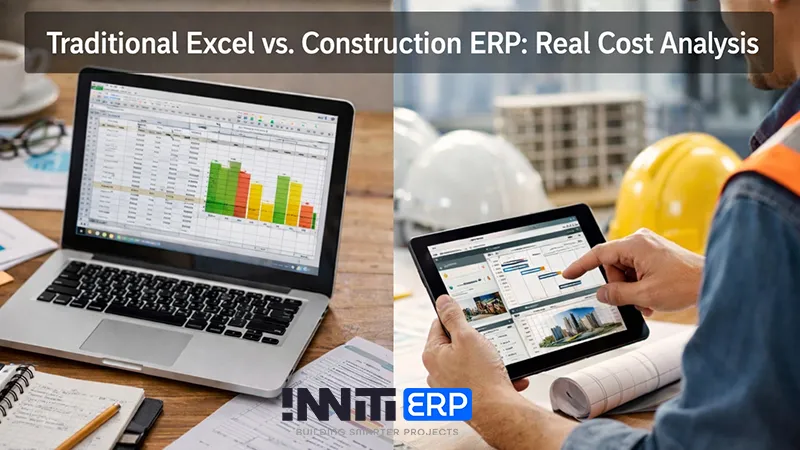
On the surface, Excel feels harmless. It’s familiar, easy to open, and most construction teams have relied on it for years. Budgets, material tracking, labour sheets, project timelines—everything ends up in spreadsheets. At first glance, it works. Projects move forward, numbers get updated, and reports are shared. But something subtle starts happening as projects grow. Files multiply. Versions get confusing. Teams spend hours reconciling numbers instead of building. One spreadsheet becomes five, then ten, then entire folders of project files that nobody fully trusts.
That’s where the real cost begins. Construction companies across India are quietly shifting away from manual spreadsheet workflows toward structured digital systems like Construction ERP Software. The difference isn’t just about convenience—it’s about visibility, time savings, accuracy, and scalability.
Excel became the default tool for construction businesses long before specialised digital systems existed. Project managers used it for BOQs, engineers tracked material consumption, and finance teams monitored costs. It felt flexible, and for small projects, it often worked. But construction projects today are far more complex. Multiple sites, hundreds of materials, subcontractor payments, labour tracking, and procurement coordination demand something stronger than scattered spreadsheets. The biggest issue isn’t Excel itself—it’s the limitations that appear when a business grows. When spreadsheets become the backbone of operations, several operational risks start creeping in.
The first thing most companies notice when switching systems is the amount of time wasted on manual work. Manual entries look small individually but accumulate across departments. Common hidden costs of spreadsheet-based management include:
These processes might not appear on financial statements, but they quietly consume hundreds of working hours each year. A structured Construction ERP Solution in India eliminates most of these repetitive tasks by centralising project information in one system. Instead of scattered files, teams work from a shared database where updates reflect instantly. This shift alone can change how quickly management makes decisions.
Time is one of the most valuable resources in construction management. Delays in information often lead to delays in action. When spreadsheets dominate workflows, teams frequently spend hours compiling reports for management meetings. Site engineers update progress manually, finance teams verify numbers, and managers attempt to interpret fragmented data. In contrast, modern Construction ERP Software allows real-time reporting. Project progress, cost tracking, procurement updates, and financial insights become available instantly. Instead of spending hours building reports, teams simply generate them. The time saved each week quickly adds up. Project managers focus on execution instead of documentation, and leadership gains quicker access to critical insights. Many companies adopting Construction ERP Software in India discover that the productivity improvement alone justifies the transition.
Human error is one of the biggest risks in spreadsheet-driven environments. Even experienced professionals make mistakes while copying formulas, updating quantities, or modifying financial sheets. A small formula error in a project cost sheet can distort an entire financial overview. Common spreadsheet risks include:
These mistakes often remain unnoticed until financial reviews or project audits. A digital Construction ERP Solution in India significantly reduces such risks by automating calculations and standardising workflows. Instead of manual formulas, the system processes data consistently across modules. With better data accuracy, management gains confidence in project reporting and financial tracking. This reliability is one reason many companies begin exploring the Best Construction ERP Software in India when their project scale increases.
Excel works well when operations remain small and manageable. But as construction companies expand, the limitations start appearing quickly. Projects grow in size. Teams expand across cities. Procurement becomes more complex. Suddenly spreadsheets begin struggling to keep up. Some common scalability challenges include:
When a business handles several projects at once, relying solely on spreadsheets becomes increasingly difficult. This is where the Best Construction ERP Solution in India becomes valuable. ERP systems are built specifically to manage growing project portfolios while maintaining clear oversight across departments. Instead of managing disconnected files, construction companies gain a unified operational platform.
Cost control is at the heart of construction project success. Excel sheets can track costs, but they often lack the dynamic visibility needed for modern project management. Financial insights typically arrive after data compilation, which delays corrective actions. A structured Construction ERP Software connects project operations directly with financial data. For example:
This integrated visibility allows management to identify cost overruns earlier, making corrective decisions before issues escalate. Companies adopting Construction ERP Software in India frequently report improved financial clarity and stronger project control.
Construction projects are all about getting multiple teams working together: procurement teams, finance departments, site engineers, project managers and leadership. Trouble is, when each team uses its own separate spreadsheet, coordination can get pretty messy. We all know how that works - teams relying on emails and manual updates to try and keep each other in the loop, but in the end, it just slows communication down.
But a Construction ERP Solution in India can bridge that gap, by giving every department the chance to work on the one platform. So, procurement teams can track orders, finance teams can keep an eye on budgets and project managers can oversee progress - all in one system. Which makes a huge difference to how smoothly things run - because it all comes down to alignment improving coordination and reducing operational friction.
Project delays don't usually come out of the blue - they usually develop gradually over time through a series of small operational issues. Whether it's material shortages, delayed approvals or the odd budget miscalculation. Excel spreadsheets just aren't up to the job when it comes to real-time monitoring for these kinds of issues. But with a modern Construction ERP Software, you get live insights into project progress, procurement status, cost tracking and resource utilisation. So, instead of having to wait for a monthly report, leadership can get daily operational visibility. That proactive approach really helps companies stay on top of risks and keep their projects on schedule.
More and more construction companies across India are turning to digital transformation as project complexity increases and relying on spreadsheets gets riskier by the day. And they're realising the operational advantages of the Best Construction ERP Software in India too - such as:
All of which adds up to stronger project performance and bigger profits. At INNITI Software, we're helping construction businesses adopt digital tools that are tailored specifically to their industry workflows. Which means they can get on with the job, without having to work around a system that's not designed to help them.
INNITI Software is all about building practical technology solutions that really understand the operational realities of construction management. We're not into generic systems that don't quite fit - we develop specialised platforms that handle project costing, procurement tracking, financial monitoring and site coordination with one goal in mind: helping companies move away from those scattered spreadsheets and toward structured, reliable digital systems that support growth and operational clarity. From the start to the finish, our aim is always the same - helping businesses like yours enjoy the benefits of a technology partner that really understands what they need.
So many construction businesses start with spreadsheets because they feel easy and accessible. But as projects grow and teams expand, those same spreadsheets can start to create hidden operational costs - manual updates, version confusion, reporting delays and calculation errors that quietly chip away at your productivity and financial visibility. And if left unchecked, they'll eventually slow decision-making down and make project coordination more difficult.
A modern Construction ERP Software offers a much more structured approach by centralising project data, automating reporting and connecting departments through a single platform. And for construction companies looking to improve operational clarity, reduce manual workload and manage multiple projects more effectively, the transition from Excel to ERP is a no-brainer - it's a step toward stronger project control and long-term business growth.
Want to understand the real cost difference between Excel and Construction ERP Software for your projects? Contact INNITI Software today. Call +91 99040 40186 or email info@innitisoftware.com for more information.
Construction ERP Software Excel vs ERP Construction Construction Cost Management Construction Financial Tracking Construction Project Monitoring Procurement Management Construction Construction Reporting System Multi Project Construction Management Construction Workflow Automation Digital Construction Management
Scan the QR to call