
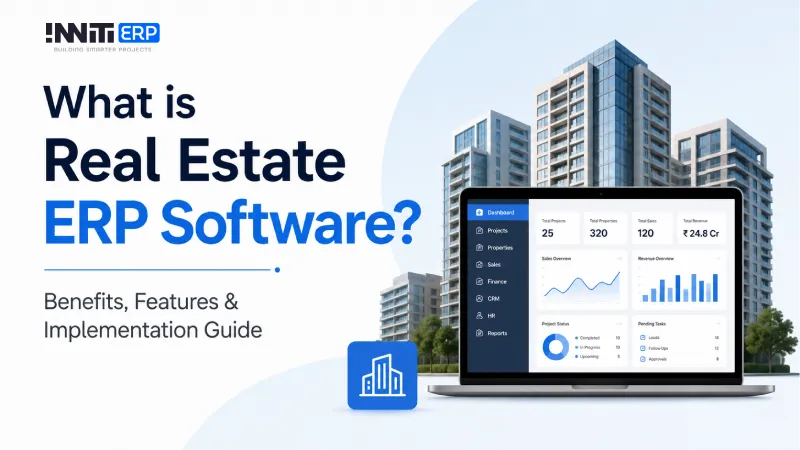
INNITI Software is a Leading Provider of Real Estate ERP Solutions.
Running a successful real estate business today requires much more than managing properties and projects manually. To stay ahead in a cutthroat market, developers, builders, and construction organizations require improved visibility, faster workflows, and real-time information. This is where ERP technology comes into the picture.
Modern businesses are rapidly adopting Real Estate ERP Software to bring different departments together and simplify day-to-day operations. From project management and accounting to customer relationships and inventory tracking, an ERP system creates a central platform that helps organisations work more efficiently.At INNITI Software, we understand the challenges faced by real estate businesses and provide solutions designed to support sustainable growth and operational excellence.
An integrated business management system created especially for real estate developers, builders, contractors, and construction firms is known as real estate ERP software..
It combines various processes into one platform, enabling businesses to handle projects, finances, purchasing, client data, and reporting all from one place.
Instead of using multiple disconnected systems, businesses can rely on one solution to improve coordination and maintain better control over operations.A powerful Real Estate ERP Solution helps organisations reduce manual work and improve information flow across departments.
The real estate industry involves multiple activities happening simultaneously. Managing projects, contractors, customer relationships, and finances manually often creates delays and communication gaps.
Implementing Real Estate Construction ERP allows businesses to:
These advantages make ERP systems an essential tool for modern real estate companies.
Choosing the right ERP platform starts with understanding its capabilities.
One of the most crucial elements of real estate ERP software is project management.. Businesses can monitor project schedules, track progress, and manage resources more efficiently.
Maintaining strong customer relationships is critical for real estate developers. CRM features help manage leads, enquiries, and customer interactions.
An effective Real Estate ERP Solution simplifies purchasing processes and improves vendor coordination.
Tracking materials and resources becomes easier with integrated inventory management capabilities.
Accounting and financial reporting features provide better control over expenses and business performance.
Businesses in the construction and real estate industries handle a lot of paperwork. ERP systems centralise information and simplify document access.
Real-time dashboards help management teams make informed decisions based on accurate data.
Businesses adopting ERP technology often experience significant operational improvements.
Managers can monitor ongoing projects and identify issues quickly.
Departments work together more effectively when information is available through a common platform.
Automation helps minimise repetitive tasks and improves efficiency.
Real-time information supports quicker and more accurate decisions.
Integrated financial modules help businesses manage expenses and reporting.
This is why many developers are investing in Real Estate Construction ERP to support long-term business goals.
ERP solutions are useful for:
A scalable real estate ERP system may help expanding companies and adjust to various operational needs.
Successful implementation requires proper planning and execution.
Businesses should identify their operational challenges and define objectives clearly.
Choosing the appropriate Real Estate ERP Software depends on business size, processes, and future requirements.
Existing business information needs to be transferred carefully into the new system.
Workers should be able to operate the software efficiently.
Once configured, the ERP system becomes part of everyday operations.
Regular monitoring and support help businesses maximise the benefits of ERP implementation.
At INNITI Software, we work closely with organisations to simplify this process and help them adopt technology with confidence.
Technology is driving the real estate sector more and more.Customers expect faster communication, and businesses require accurate information to make strategic decisions.
Modern Real Estate Construction ERP platforms support digital transformation by providing:
Companies embracing technology today are better prepared for future growth.
While software selection is important, selecting the appropriate technology partner is just as crucial.
Businesses should consider:
A dependable Real Estate ERP Solution should support business expansion and adapt to changing requirements.
The future of ERP systems will definitely be associated with connectivity and smartness. In fact, real-time reports, mobile usability, and workflow integration are now critical factors that must be taken into account by software providers and constructors.
Enterprises leveraging the power of Real Estate ERP Software can enhance their transparency, boost collaboration efforts, and optimize their processes.ERP systems will undoubtedly continue playing an important role in the future of the real estate sector amid growing trends related to digital transformation.
At INNITI Software, we remain dedicated to empowering organizations and embracing innovative technologies.
The real estate and construction business is known for its intricacies, and at we understand INNITI Software, that well. Our emphasis is always on offering our customers effective, scalable ERP solutions that make life simpler for them in the areas of project management, customer relations, procurement, inventory management, and finance among others. We always take our time to understand the needs of our customers so that we can develop solutions that meet their business requirements today and for the future. INNITI Software stands for innovation and excellence in the support of our customers.
ERP Software for Real Estate is now indispensable for real estate developers and businesses engaged in the process of constructing buildings and other facilities. The benefits of an ERP software system are obvious because all business processes can be performed within one system, which increases its efficiency and improves its performance. An organization using ERP systems is much more efficient in coping with its tasks and adjusting itself to the changing needs of the market. INNITI Software offers specialized ERP software for various industries.
Want to explore the right Real Estate ERP solution for your business? Contact INNITI Software today at +91 99040 40186 | Email: info@innitisoftware.com for expert guidance.
Real Estate ERP ERP Software Property Management Real Estate Developers Construction ERP CRM Software Project Management Business Automation ERP Implementation Real Estate Technology
Scan the QR to call